Breaking into the world of Anti–Money Laundering (AML) and Financial Crime Compliance is never a simple road – but some stories stand out for their discipline, resilience, and purpose.
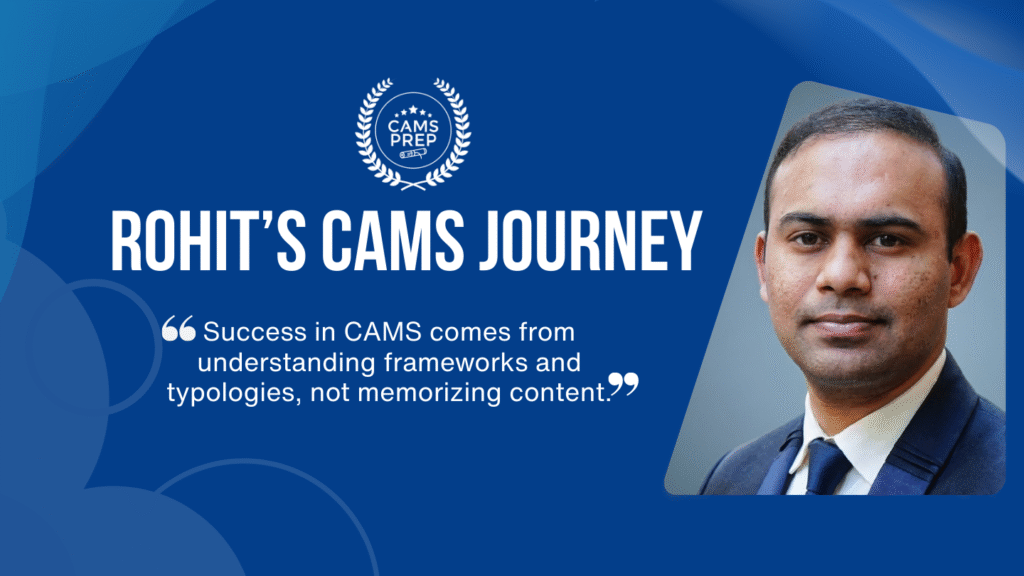
One such story is that of Peddina Venkata Rohit – an Indian Army Veteran turned Compliance & Vigilance leader, now a proud Certified Anti–Money Laundering Specialist (CAMS).
With 13 years of leadership experience, including 11 years as a Commissioned Officer, Rohit forged a second career rooted in governance, risk management, and financial crime prevention. Today, as Assistant General Manager – Compliance & Vigilance at Jindal Saw Ltd., Nashik, he leads enterprise-wide audits, fraud risk mitigation, regulatory liaison, and compliance controls across high-risk operational environments.
His transition from military intelligence to financial crime compliance is a reminder that discipline, structure, and a sense of duty can build remarkable careers — even in entirely new fields.
🎙️ Interview with Rohit
In this exclusive CAMS PREP interview, Rohit shares his CAMS journey in his own words, offering practical, honest, and deeply motivating insights for every aspirant.
1. Can you introduce yourself and your current role?
I come from a military background, and my experience as a Commissioned Officer shaped my approach to vigilance, discipline, and operational risk. In my current role, I oversee risk assessments, maintain process integrity, implement controls, and coordinate with regulatory bodies.
2. What motivated you to pursue the CAMS certification?
I wanted to transition into a specialized career within financial crime and AML. With financial crime becoming more sophisticated globally, I felt the need for a structured, internationally recognized qualification. CAMS offered exactly the kind of depth, credibility, and global relevance I needed to strengthen my AML expertise.
3. How does CAMS align with your long-term goals?
My long-term goal is to grow from AML Investigations and Transaction Monitoring into roles such as Financial Crime Advisory or FCC Governance. CAMS fits perfectly because it validates my technical knowledge and enhances my investigative and analytical skills — which are essential for advancing in this field.
4. How long did you prepare, and what was your study schedule?
My study routine was structured and disciplined:
- Weekdays: 1 to 1.5 hours
- Weekends: 3 to 4 hours, mostly revision and practice
- Last two weeks: Complete focus on full mock exams and reviewing weak areas
I relied heavily on the ACAMS Study Guide, flashcards, glossary, and practice questions -these were my primary tools.
6. What was your learning style?
My learning style was a mix of:
- Building a strong foundation through the Study Guide
- Practicing scenario-based questions
- Creating concise one-page summaries
- Repeating flashcards and revisiting weaker topics
For me, success in CAMS comes from understanding frameworks and typologies, not memorizing content.
7. What was your exam-day experience like?
Exam day was smooth and organized. I reached early and used the time to quickly revise important areas like red flags, SAR requirements, sanctions, and FATF recommendations. The exam required calmness and analytical thinking, especially with the scenario-based questions.
8. Which topics appeared more than expected?
I noticed a strong focus on:
- Transaction monitoring red flags
- SAR narrative quality
- Sanctions, PEP risks, correspondent banking
- FATF’s risk-based approach
- CDD versus EDD requirements
- Roles of regulators and FIUs
9. What surprised you about the CAMS exam?
What stood out to me was how much judgment the exam required. You must think like a compliance professional — not like a student selecting the “right answer.” The exam tests your ability to apply a risk-based approach.
10. Your one golden tip?
Understand the concepts – don’t memorize. ACAMS tests how you think. Also, revision is the mother of memory – keep revisiting your notes and flashcards consistently.
11. How can professionals balance work and CAMS preparation?
My strategy was simple:
- Set a realistic weekly study plan
- Study in short, consistent blocks of 45–60 minutes
- Use weekends for deeper revision
- Use flashcards during short work breaks
- Reserve the last two weeks exclusively for mocks
Rohit’s journey teaches us one powerful truth: Your background does not limit your future – your discipline and consistency build it.
Whether you come from banking, operations, law enforcement, or even the military like Rohit, CAMS can transform your career if you commit to understanding, practicing, and revising.
If he could make such a successful transition, so can you.