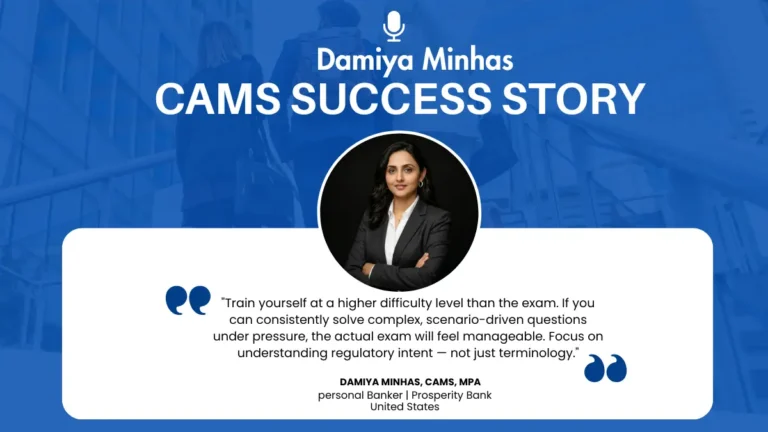



Rakesh Kumar spent eight years processing SWIFT payments, settling securities, and managing corporate actions at some of the world biggest banks.
After nearly a decade at Standard Chartered Bank and BNP Paribas, Rakesh decided to pursue CAMS. He enrolled in the CAMS Prep Masterclass, passed it, and is now targeting Transaction Monitoring roles in Germany – bringing with him a rare combination of deep operational knowledge and AML expertise.
We sat down with Rakesh to hear how an operations specialist turned custody expert made the shift to Compliance – and what was success secret in passing the CAMS exam.
Can you introduce yourself and your current role?
Rakesh Kumar: I am Rakesh Kumar Kamatchi, a Corporate Actions Operations Specialist with over 8 years of experience in global custody operations, securities settlement, and capital markets back office. I have worked with Standard Chartered Bank and BNP Paribas, handling everything from SWIFT messaging and corporate actions processing to cash reconciliation and client instructions.
Most recently, I was a Team Lead at Standard Chartered Bank Global Business Services in Bangalore, where I managed end-to-end custody operations and led a team across multiple functions. I am currently based in Sulzbach am Main, Germany, and I recently cleared the CAMS exam.
What motivated you to pursue the CAMS certification?
Rakesh Kumar: Working in back-office operations for nearly a decade, I dealt with payment flows, SWIFT transactions, FX transfers, and client instructions on a daily basis. Over time, I realized that financial crime risks are embedded in every layer of what we do – a suspicious corporate action payment, an unusual FX transfer pattern, a client instruction that doesn’t quite add up.
I had already completed foundational AML and KYC certifications through Alison – Introduction to AML Regulations, KYC & Customer Due Diligence, and Fundamental Principles of AML – and those ignited a genuine passion for the subject. CAMS felt like the natural next step – a globally recognized credential that would formalize and deepen that knowledge at a professional level.
How does CAMS align with your long-term goals?
Rakesh Kumar: My long-term goal is to transition from pure operations into financial crime risk compliance, with Transaction Monitoring as my immediate target — it’s where my operational background and CAMS knowledge intersect most naturally.
I’ve spent years processing the exact transaction types that TM systems flag: SWIFT payments, FX transfers, correspondent banking flows, and corporate action payments, so I can bring both technical depth and regulatory awareness to alert investigation from day one.
Germany and the broader EU have very stringent AML frameworks, especially post-AMLA reforms, and CAMS positions me credibly at that intersection of back-office expertise and compliance knowledge — a combination that is genuinely rare in the TM space.
Longer term, I see myself progressing from TM Investigator into a Senior Investigator or AML Compliance Officer role, and CAMS is the foundation that makes that entire path structured and achievable.
How long did you prepare, and what was your study schedule?
Rakesh Kumar: I prepared for approximately four months. My schedule was structured but realistic – about 1.5 to 2 hours on weekdays and around 4 hours on weekends. I divided the ACAMS study guide into weekly modules, ensuring I covered each chapter without rushing.
One thing that really accelerated my understanding was enrolling in the CAMS Prep Masterclass – it helped me grasp complex concepts much more clearly than self-study alone, especially areas like risk-based approach frameworks and typologies. The instructor-led structure kept me accountable and gave me a solid conceptual foundation to build on.
Having already completed the Alison AML certifications beforehand also helped – by the time I was deep into CAMS prep, I wasn’t starting from scratch. I could focus more on application and case-based thinking. The last three to four weeks were dedicated entirely to practice questions, mock exams, and reviewing weak areas before the exam.
What was your learning style?
Rakesh Kumar: I am very much an active learner. Simply reading through the study guide wasn’t enough for me – I needed to connect concepts to real-world examples from my own work.
For instance, when studying typologies, I would mentally map them to transactions I had processed – unusual FX patterns, layering through multiple correspondent bank accounts, or complex corporate action elections that didn’t match a client’s typical behavior.
I also made handwritten summary notes for each chapter, created comparison tables — for example, FATF recommendations vs. EU directives – and used flashcards for definitions and key thresholds. Practice questions after every chapter were non-negotiable for me.
What was your exam-day experience like?
Rakesh Kumar: Honestly, it was intense but manageable. The exam is 3.5 hours long with 120 questions, and time management is critical. I made sure to read every question carefully – CAMS questions are scenario-based and often hinge on a single word like “first” or “best,” which can completely change the right answer.
I flagged questions I was uncertain about and moved on, then came back with fresh eyes. The first 30 minutes felt the most pressured, but once I settled into a rhythm, I felt more confident. Walking out, I was cautiously optimistic – and when the result came through, it was a great feeling.
Which topics appeared more than expected?
Rakesh Kumar: Two areas stood out. First, Beneficial Ownership and Customer Due Diligence – there were far more nuanced scenario questions around UBO identification, enhanced due diligence triggers, and PEP classifications than I anticipated.
Second, Correspondent Banking and SWIFT-related risks – which actually played to my strengths given my SWIFT messaging background, but I hadn’t expected it to feature so prominently. Questions around Nostro/Vostro relationships, payable-through accounts, and nested correspondent banking were quite detailed. My practical experience with MT103, MT202, and settlement flows definitely helped me navigate those scenarios more confidently.
Your one golden tip?
Rakesh Kumar:
“Don’t just memorize — think like a compliance officer, not a student. CAMS doesn’t reward rote learning. It rewards judgment.”
Every scenario question is asking: given this situation, what is the most appropriate, risk-based, proportionate response? Practice asking yourself “why” after every answer you choose. And tie the content back to real transactions whenever possible — if you’ve worked in banking, you already have more context than you realize. Use it.
How can professionals balance work and CAMS preparation?
Rakesh Kumar: Consistency beats intensity. You don’t need 5-hour study marathons — you need 90 minutes every single day, with no exceptions. Protect that time like a meeting you cannot cancel.
I made the most of my mornings for deep study when my mind was fresh, and used afternoon sessions for flashcard reviews and practice questions. On tougher days, I would do a lighter review session rather than skipping entirely — skipping creates momentum loss.
“When you relate typologies and red flags to actual payment flows and reconciliation situations you’ve encountered, the concepts stick far more naturally — and the exam feels much more intuitive when the day comes.”
Final Remarks
Rakesh Kumar didn’t need a career pivot. He needed a credential that matched what he already knew. Nearly a decade of SWIFT messaging, settlement flows, and back-office operations had given him a front-row seat to the very transaction types that financial crime investigators chase – he just hadn’t formalized it yet.
Four months of structured preparation, a willingness to connect theory to his own lived experience, and one passed exam later, he’s positioned exactly where he set out to be: at the intersection of operations depth and compliance knowledge, targeting Transaction Monitoring roles in one of Europe’s most demanding AML environments.
If you want to succeed like Rakesh, enroll in CAMS Prep Masterclass.