

CAMS Certification 101
If you work in compliance or financial crime prevention, you probably already know what is CAMS certification. Literally it shows up everywhere – LinkedIn profiles, email signatures, and job advertisements.
And when you start thinking pursuing CAMS certification, so many questions pop up in your mind. How do I start? Am I eligible for the exam? How hard is the exam? What does it cost? What if I fail on my first attempt and can I reattempt? Where can I get learning materials or a mentor to begin with? And so on…..
You probably have all these questions in your mind all the time and keep searching answers. At the end of this article you will get a holistic overview of the CAMS exam and have little confusion. If you are completely new to CAMS, our beginner’s guide to CAMS certification is a good starting point.
What Is CAMS Certification?
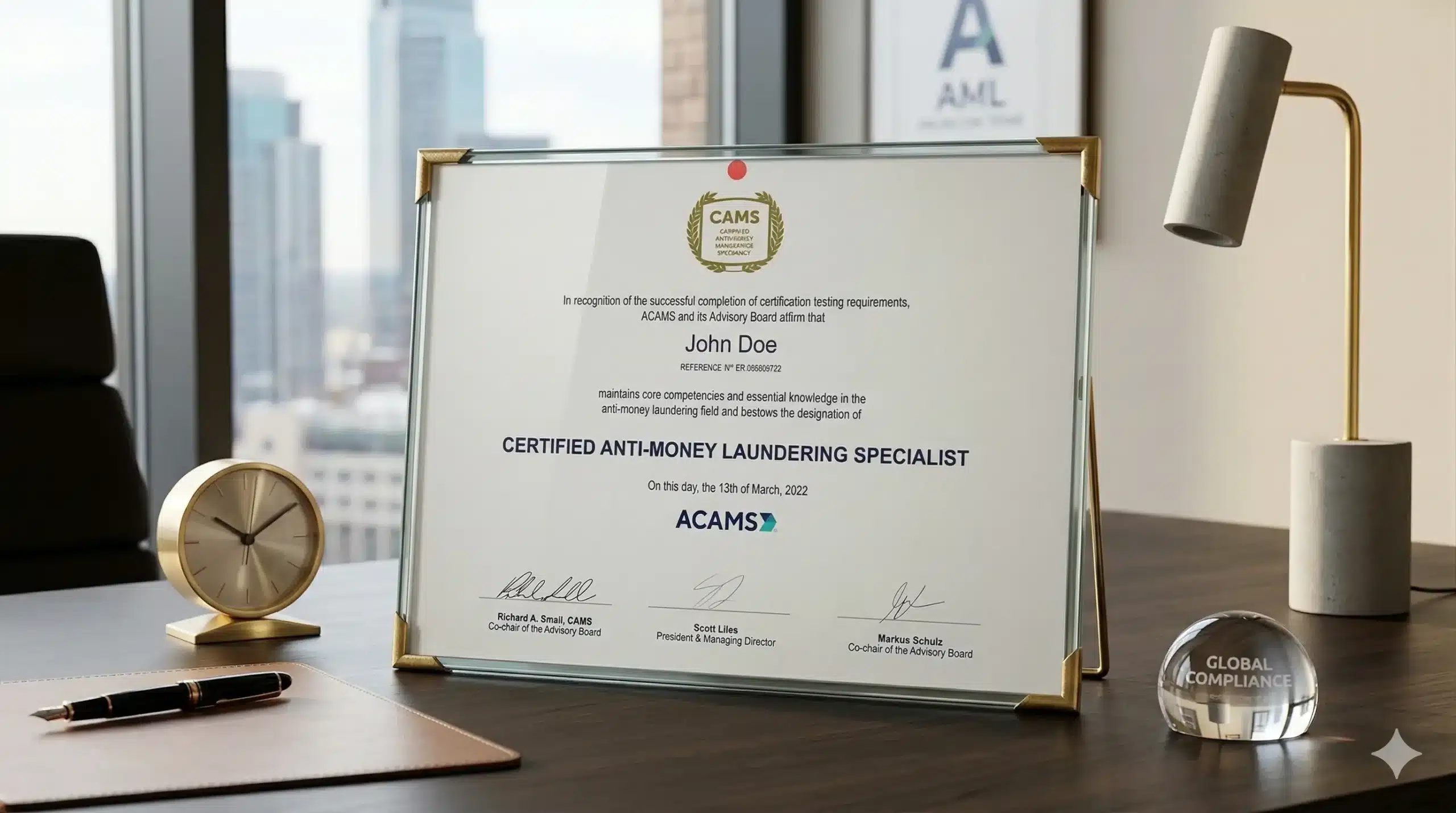
CAMS, which stands for Certified Anti-Money Laundering Specialist, is one of the most recognized certifications in the field of AML and financial crime prevention. The CAMS certification exam is administered by the Association of Certified Anti-Money Laundering Specialists (ACAMS), a leading international body for anti-money laundering professionals.
CAMS certification demonstrates that you understand the core principles of AML compliance, financial crime risk, detection methods, regulatory expectations, investigations, sanctions-related awareness, and how organizations build effective compliance programs. It also indicates that you just don’t understand AML/CFT compliance at surface level rather you have deeper understanding and professional competence at a level beyond any ordinary compliance professionals industry.
Many professionals spend years reviewing alerts, investigating cases, doing screening, managing relationships and participating in compliance processes without ever developing a broader understanding of how the overal AML/CFT compliance framwork works. CAMS certification pushes your thinking beyond that specific role(s) you are in. It forces you to connect operational work with risk, governance, regulation, institutional accountability, and even national security.
A CAMS certified professional has broader understanding of financial crime risks and s/he can apply that knowledge to any jurisdiction/ industry specific AML/CFT challenges. That’s why the CAMS certification carries weight across banks, fintech companies, payment institutions, regulatory bodies, consulting firms, casinos, law firms, and other sectors exposed to money laundering risk.
Why CAMS Certification is the Gold Standard in AML

People often call CAMS as the “gold standard” in AML certification. It’s not just a marketing language to pull more candidates towards the certification. CAMS has built strong recognition across the financial crime compliance world, and that matters because AML is no longer a narrow, local discipline.
Criminal networks move money across borders, through shell entities, trade channels, crypto platforms, intermediaries, and digital payments. So employers increasingly want professionals who can think beyond one set of domestic rules.
One of the biggest strengths of CAMS Certification is portability. Many credentials are respected only within certain industries or countries. CAMS has broader recognition, which makes it useful if you want to work for multinational institutions, cross-border financial firms, consulting networks, or global fintech businesses.That means the letters after your name can travel with you. Your experience may be local, but the credential gives it a more universal frame.
An AML specialist deeply understands how criminals exploit gaps in process, systems, human behavior, and across regulatory fragmentation. CAMS pushes you toward that mindset. After CAMS certification you become better at reading risk patterns, understanding typologies, identifying weaknesses in controls, and seeing where compliance programs fail before those failures become regulatory problems.
Another underrated part of CAMS Certification is the network effect. Being connected to a broader professional ecosystem helps you stay current. With CAMS certification you become a member of the largest association in AML and get connected with professionals across the world. That matters more than it sounds. In AML, isolation makes you outdated.
Certainly, there is not just one single reason you should pursue CAMS certification. CAMS certification can unfold many opporunties that you did not know about.
CAMS Exam Eligibility Requirements
So, now that you have a broader understanding of CAMS certification, the obvious next question is – what makes you eligible for the exam? Before you can sit for the exam, you need to meet the eligibility criteria as defined by the ACAMS. CAMS certification typlically require two things:
- An active ACAMS membership
- A minimum of 40 eligibility credits
Those 40 credits are built from your education, work experience, and training.
How the CAMS eligibility credit system works
The CAMS eligibility credit system is pretty flexible and welcoming. Whether you already work in this field for 20 years or just completed your education, it gives you flexibility to meet eligibility requirements. You can earn credits from your past academic education, industry experience, and training you have attended in the past.
So you are closer to CAMS eligibility than they think. If you don’t have much work experience that’s not a problem you can always pull credits from other categories. Interestingly, you can even meet the full 40 eligibility credits from one single category. For example, you have a JD/PHD degree that means you would not need any other credits from the remaining category. Similarly, if you have significant work experience, then you can claim all credits from one single credit category and show ACAMS that your 40 credits come all from one single category.
Whatever evidence you submit to claim 40 credits eligibility, you must remember that you should provide all the supporting documentation. Any fraudulent documentation / evidence can disqualify you from sitting for the CAMS exam.
CAMS Certification Cost Breakdown
Let’s talk about the part everyone quietly worries about: the price. CAMS Certification is not cheap. And honestly, it shouldn’t be treated like an impulse purchase. It’s a professional investment, and you should budget for it properly rather than focusing only on the headline fee. For a full analysis of whether the investment makes sense for your career, see our breakdown of CAMS exam fees and return on investment.

Whether you belong to the private sector or public sector, you may qualify for further discounts depending on whether your current organization has any partnership with ACAMS. Moreover, ACAMS occasionally provides discounts on special events and basis income level of candidates applying from certain low GDP countries.
You can opt out from virtual classroom options and alternatively join CAMS Prep MasterClass which saves a lot of time and money. CAMS Prep MasterClass helps you complete your preparation in less than 2 months.
CAMS Retake and Reschedule Fees

Even with your months of preparation if you fail short of a few marks in the exam, you need to retake the exam. If you don’t pass the exam on your first attempt, you’ll need a new authorization to test.
Typical retake costs; Private sector: US$299, Public sector: US$199
Rescheduling online is completely free if done more than 72 hours before your test. If you change your date within that 24 to 72-hour window, you will be hit with a $100 penalty fee. Never no-show or cancel with less than 24 hours’ notice, because you will have to pay the full retake fee all over again.
CAMS Recertification Renewal Process
A lot of people think of certifications as one-and-done milestones. CAMS doesn’t really work like that. To keep using the credential, you generally need to maintain active membership and complete recertification requirements every three years.
This process is designed to ensure that professionals stay up-to-date with evolving anti-financial crime trends, new regulatory frameworks, and shifting typologies.
The core requirement for renewing your certification is accumulating a total of 60 continuing education credits over your three-year cycle. Alongside these credits, you are strictly required to maintain an active, uninterrupted ACAMS membership throughout this entire period to remain eligible for renewal.

How to Earn Your 60 Recertification Credits
While you need 60 total credits, there are a few specific rules governing them. The handbook provides a detailed matrix of activities you can complete to earn your credits.
CAMS recertification credits can be earned through professional work, ACAMS membership, training, certifications and industry contributions. Full-time experience and active membership provide steady annual credits, while attending trainings, events, or earning certifications adds more.
Additional credits can come from teaching, speaking, publishing, volunteering or expert roles. Overall, there are multiple flexible ways to add the required credits within each cycle.
Recertification Fees
When it is time to renew your certification at the end of your three-year cycle, you must submit a recertification application along with a corresponding renewal fee. The cost of this fee is tiered based on how early you submit your application:
- Early Application: US$200 (if your application is postmarked by October 1)
- Regular Application: US$250 (if your application is postmarked by December 15)
- Late Application: US$300 (if your application is postmarked by March 31)
If you experience extenuating circumstances that prevent you from meeting your continuing education credits or submitting your recertification application on time, you have the option to apply for a one-year extension. The fee for requesting this one-year extension on your recertification is US$100.
Is CAMS Worth the Investment?
There are other ACAMS certifications that focus on narrower areas of financial crime, such as sanctions, fraud, or crypto-related compliance. These can be excellent options if you’re already established in a niche.
But for most professionals, CAMS remains the broadest and most strategic starting point. It gives you the foundational anti-financial crime lens that specialist programs build on top of. In most cases, specialist credentials make more sense after you’ve established a strong AML base.
There are other ACAMS certifications that focus on narrower areas of financial crime, such as sanctions, fraud, or crypto-related compliance. These can be excellent options if you’re already established in a niche.
But for most professionals, CAMS remains the broadest and most strategic starting point. It gives you the foundational anti-financial crime lens that specialist programs build on top of. In most cases, specialist credentials make more sense after you’ve established a strong AML base.
You may also compare CAMS to credentials tied to fraud examination, regulatory compliance, crypto compliance or audit.
Those can absolutely be valuable, but they serve different professional identities. If your career is centered specifically on money laundering, financial crime controls, suspicious activity review, customer risk, transaction monitoring, and AML governance, then CAMS is more directly aligned with your day-to-day reality. Whether CAMS certification worth it or not, depends on your personal and professional objectives. You can also read top 5 reasons why you should pursue CAMS certification.
Is CAMS the Best AML Certification?
Saying any certification is “the best” always needs context. Best for whom? Best for what stage? Best for which role?
That said, CAMS Certification is widely regarded as the strongest general AML credential for professionals who want broad recognition and serious career relevance.
Why do many professionals rank CAMS first? The reason isn’t hype. It’s fit. CAMS covers the major pillars of anti-money laundering and financial crime prevention, supporting both operational roles and leadership progression. It gives you range. That makes it more versatile than many niche certifications.
CAMS works especially well for generalist and leadership paths. If you want to become an AML manager, compliance lead, MLRO, financial crime consultant, or strategic risk professional, CAMS is hard to ignore. It helps bridge the gap between technical execution and organizational oversight.
If your role is highly specialized, say sanctions only, crypto crime only, or KYC operations only then a specialist certification might eventually serve you better in that narrow lane.
Career Opportunities After CAMS Certification
You’re not getting certified just to admire a digital badge. You want to know where it can take you. The good news is that CAMS Certification can support CAMS certification for your AML career movement across multiple sectors and job functions.

Your title will still depend on your prior experience, location, and industry. CAMS helps, but it doesn’t replace real-world exposure. Still, it can absolutely accelerate the move from junior analyst work into more strategic positions.
Industries that value CAMS
With CAMS certification you can possibly work in multiple industries. People often think Banking sector is the primary option but that’s not entirely true. There are different sectors where organizations require competent compliance officers to prevent money laundering and various other financial crimes.
In recent times crypto industry is booming, Fintech and technology platforms are also increasingly hiring professionals with CAMS certifications. You can also leverage your CAMS certification in consulting firms, real estate companies, investment firms, gaming sector, and various payment service providers.

Anywhere there is customer onboarding, fund movement, transaction risk, complex beneficial ownership or reporting obligations, AML expertise becomes valuable.
CAMS exam format and blueprint
If you want a complete walkthrough of exam strategy, preparation timeline, and study resources, see our CAMS Exam Guide. People sometimes approach this exam like a memory test. That’s a mistake. Yes, you need to know concepts, frameworks and terminology. But the exam is not really rewarding rote memorization. It’s a test of whether you can think like an AML professional in practical conditions.
The CAMS examination is a timed test that consists of 120 multiple-choice and multiple-selection questions. You will have 3.5 hours to complete the entire exam.
To successfully earn your certification, you must achieve a passing CAMS exam passing score of 75. It is highly recommended to answer every question because there is no penalty for guessing, so avoiding blank answers will maximize your chances of passing.
The questions on the exam are distributed across four main domains:

Don’t study these domains in isolation. Connect them; Criminal methods affect institutional controls, Controls connect to regulatory expectations, Technology affects detection, and Detection drives investigations. That interconnected thinking is what strengthens performance in your exam.
Exam Preparation Strategy
Not everyone needs instructor support. But some people really do benefit from it. An instructor, who passed CAMS, can certainly guide you how to set yourself up for the exam. Working professionals are often balancing exam prep with demanding jobs, and self-study can drag if life gets chaotic.
That’s why a structured and routine study plan is extremely important to pass the exam on your first attempt. CAMS Prep MasterClass helps you complete your preparation in less than 2 months. You get a dedicated instructor who walks you through the whole process, syllabus, exam topics, and shares tips on how to ace the exam.
CAMS PREP’s 10 full length Mock Tests, 800+ Flashcards, 35+ Chapter wise tests, and 40+ topic wise tests basically all you need to prepare for the exam. Quizzes, flashcards, and mock tests are categorized in such a way so that you can progress in a steady manner. CAMS Prep’s practice materials simulate real CAMS exam experience and also help you build time management skills that are very crucial for the exam.
And if you struggle understanding the concepts or need an expert who can walk you through the whole journey, then you can enroll in CAMS PREP Masterclass. Through this training program you can complete your CAMS preparation journey in less than 2 months.
Final Thoughts on CAMS Certification
Earning your CAMS certification is a meaningful achievement, but what truly matters is what you do with it afterward. The knowledge you gain can open doors, but staying curious, connected, and committed will keep those doors open.
Use your certification as a tool to grow, contribute, and stay relevant in an ever-evolving field. With consistent effort, it won’t just be a qualification – it will become a defining part of your professional journey.
If your career touches AML in any serious way, this certification can do more than polish your resume. It can sharpen how you think, change how others trust your expertise, and move you closer to the kind of work where your decisions actually shape the outcome. And in financial crime compliance, that shift from doing the work to being relied on for the right call is where real careers are built.
Frequently Asked Questions
No degree is required. You need an active ACAMS membership and 40 eligibility credits, earned through education, work experience, or AML training. Use the free ACAMS Eligibility Calculator to check your status before applying.
The exam fee is $1,895 for private sector or $1,445 for public sector, including study materials and first attempt. Add $275/year for required ACAMS membership. The optional Virtual Classroom bundle costs $2,495.
The exam has 120 multiple-choice questions; you need 75 correct to pass. Roughly 6 in 10 candidates pass on their first attempt. Most AML professionals are ready after 8–12 weeks of focused study.
Yes. CAMS-certified professionals earn up to 30% more than non-certified peers, with entry-level salaries from $60,000–$90,000 and senior roles exceeding $150,000. Recognized in over 180 countries.
Yes, CAMS renews every 3 years. You need 60 recertification credits (at least 12 from ACAMS) plus an active membership. Submit renewal by December 15 of your third year to avoid late fees.