

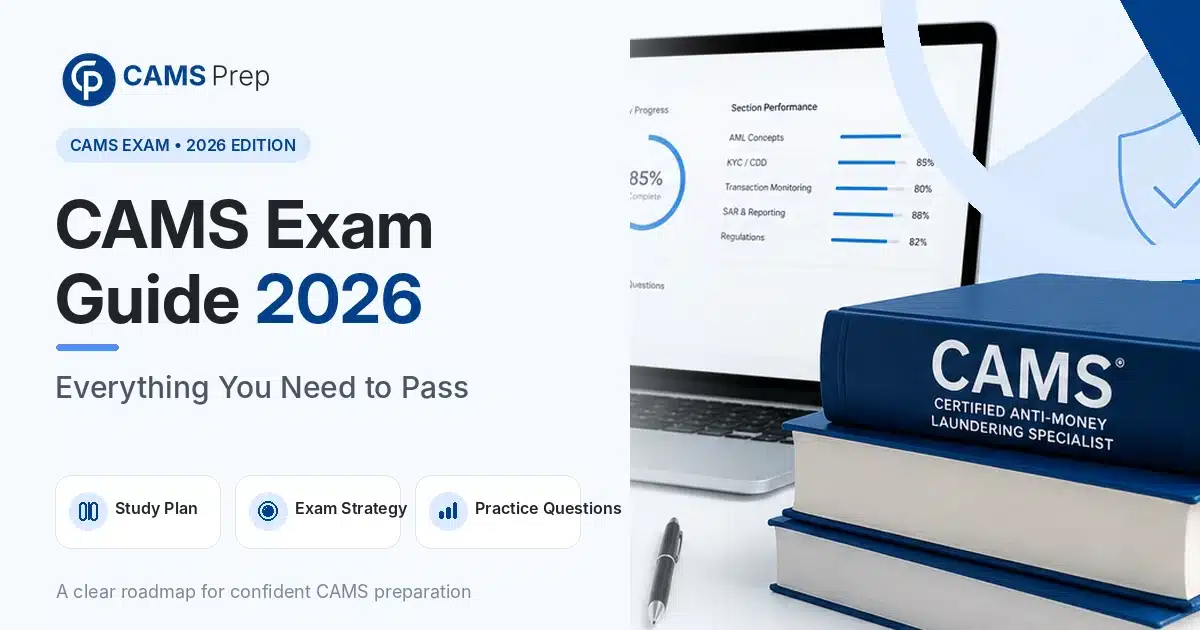
This CAMS exam guide covers everything you need to earn your Certified Anti-Money Laundering Specialist designation in 2026. Whether you are evaluating the certification, planning your study schedule, or looking for CAMS exam strategy, this article walks you through the exam format, domain weights, eligibility requirements, costs, how long to study for the CAMS exam, and career outcomes. For a broader overview of everything you need to know about CAMS certification, including why it matters and how it compares to other credentials, see our full certification guide.
Notably, the CAMS credential remains the most recognized AML/CFT certification globally, backed by ACAMS and its network of over 100,000 members in 180+ jurisdictions.
- The CAMS exam consists of 120 multiple-choice CAMS exam questions, 3.5 hours exam, requiring a 75 scaled score minimum to pass
- Four domains are tested:Risk and methods of Financial Crimes (30%), Compliance governance and frameworks(20%), Designing Compliance program (30%), and Tools and technologies to fight financial crimes (20%)
- Costs US$2,095–2,495 (private sector) or US$1,595–2,095 (public sector), depending on tier.
- CAMS-certified professionals earn an average of $89,000/year, with senior roles reaching $155,600 to $306,800 (PayScale, Jan 2026; Indeed, July 2026)
- Experienced candidates need 8 to 12 weeks of dedicated study (10 to 15 hours/week) to pass on their first attempt
- The global AML market is growing at 17.8% CAGR through 2030, creating sustained demand for certified AML professionals
What Is CAMS?
The Certified Anti-Money Laundering Specialist (CAMS) credential is a professional certification issued by the Association of Certified Anti-Money Laundering Specialists (ACAMS). Founded in 2002 and headquartered in Miami, Florida, ACAMS is the largest international membership organization focused on AML/CFT compliance, with over 100,000 members working across 180+ jurisdictions worldwide.
CAMS validates a professional’s ability to detect, prevent, and report money laundering and terrorist financing activity. The certification is recognized across banking, insurance, fintech, consulting, law enforcement, and regulatory bodies. Major financial institutions, including Deloitte, JPMorganChase, TD Bank, PNC, BNY, and MUFG, actively require or prefer CAMS-certified candidates for compliance-related positions.
The credential serves three primary purposes:
- Career differentiation: Demonstrates specialized AML expertise to employers and regulators
- Regulatory alignment: Validates knowledge of FATF Recommendations, BSA/AML requirements, EU Anti-Money Laundering Directives, and other frameworks
- Professional network: Grants access to ACAMS conferences, webinars, research publications, and a global peer community
Unlike general compliance certifications, CAMS focuses exclusively on financial crime prevention. This specialization makes it the credential of choice for professionals building careers in AML, sanctions screening, transaction monitoring, and suspicious activity reporting.
CAMS Exam Format and Structure
The CAMS exam is a computer-based test delivered through Pearson VUE, either at a physical testing center or via remote proctoring from your home or office. Understanding the format helps you allocate your study time and build effective test-taking strategies.
Exam Specifications
| Component | Detail |
|---|---|
| Question count | 120 |
| Time limit | 3.5 hours (210 minutes) |
| Passing threshold | 75 (scaled scoring) |
| Delivery method | Pearson VUE test center or remote proctoring |
| Question types | Multiple-choice and Multiple selection questions |
| Results timeline | Immediate (Certificate delivery takes weeks to arrive) |
| Scheduling | Year-round availability |
Time Management
At 120 questions in 210 minutes, you have roughly 1.75 minutes per question. Some questions require reading a brief scenario before selecting the best answer, which can take 3 minutes or more. Straightforward definitional questions may take 30 seconds. The key is to maintain a steady pace and flag difficult questions for review rather than spending excessive time on any single item.
Remote vs. Test Center
Both delivery options follow identical exam content and timing. Remote proctoring requires a webcam, stable internet connection, and a private room free of materials or other people. Test centers provide a controlled environment with lockers for personal belongings. Choose whichever option minimizes your stress on exam day.
CAMS Exam Domains and Content Areas
The CAMS exam tests four content domains. Each domain carries a different weight, which should directly influence how you allocate study hours. Candidates who distribute their preparation according to these weights consistently perform better.
Domain 1: Risk and Methods of Financial Crimes (30%)
This is the heaviest-weighted domain and covers the methods criminals use to launder proceeds or finance terrorism. You need to understand the three stages of money laundering (placement, layering, integration), identify typologies across different industries, recognize red flags in various transaction patterns, and understand the vulnerabilities of specific products and services.
Key topics include:
- Predicate Crimes and Money Laundering
- Types of Financial Crime
- Money laundering risk in banking and non-banking sector.
- Trade-based money laundering schemes
- Real estate and shell company exploitation
- Cryptocurrency and virtual asset risks
- Hawala and informal value transfer systems
- Terrorist financing methods and proliferation financing
- Politically exposed persons (PEPs) and corruption risks
Domain 2: Global AFC Frameworks, Governance, and Regulations (20%)
This domain tests your knowledge of the legal and regulatory framework underpinning AML/CFT efforts globally. You need to know the key provisions of major legislation and understand how international standards translate into national requirements.
Critical frameworks include:
- FATF 40 Recommendations and Mutual Evaluations
- US Bank Secrecy Act (BSA) and USA PATRIOT Act
- EU Anti-Money Laundering Directives (current through 6AMLD)
- UK Proceeds of Crime Act and Money Laundering Regulations
- OFAC sanctions programs and screening requirements
- Wolfsberg Group principles for correspondent banking
Domain 3: Building an AFC Compliance Program (30%)
This domain examines your ability to build and maintain an effective compliance program. Questions focus on the structural components every program needs and how they work together to mitigate institutional risk.
Core program elements tested:
- Risk assessment methodology (institutional and customer-level)
- Customer due diligence (CDD) and enhanced due diligence (EDD)
- Know Your Customer (KYC) procedures and beneficial ownership
- Transaction monitoring systems and alert management
- Suspicious activity reporting (SARs/STRs)
- Independent testing and audit functions
- Training program design and delivery
- Board and senior management oversight responsibilities
Domain 4: Tools and Technologies to Financial Crimes (30%)
The investigations domain covers the practical skills needed to research and document suspicious activity. While it carries the lowest weight, it often produces the most scenario-based questions on the exam.
Topics covered:
- AFC technology overview
- AFC technologies across customer lifecycle
- TM, Screening, KYC, and Payment technologies
- Investigation planning and case management
- Open-source intelligence (OSINT) techniques
- Following the money through complex transaction chains
- Working with law enforcement and filing referrals
- Evidence preservation and documentation standards

Eligibility Requirements
ACAMS uses a 40-credit point system to determine eligibility. Credits are earned through a combination of education, professional experience, and relevant certifications. You do not need to work in banking specifically; candidates from law enforcement, legal, consulting, regulatory, and technology backgrounds all qualify through various pathways.
Credit Allocation by Education
| Qualification | Credits Awarded | Additional Experience Needed |
|---|---|---|
| Doctoral degree (PhD, JD) | 40 credits | None |
| Master’s degree | 35 credits | 1 year in AML/financial crimes or 5 Training credits |
| Bachelor’s degree | 30 credits | 1 year in AML/financial crimes or 10 Training credits |
| Associate’s degree or diploma | 20 credits | 2 years in relevant field or 20 Training credits |
| No degree | 0 credits | 4 years in AML/financial crimes or 40 Training credits |
Additional Credit Sources
Professional certifications contribute supplemental credits toward the 40-point threshold:
- CFE (Certified Fraud Examiner): 10 credits
- CIA (Certified Internal Auditor): 10 credits
- CPA (Certified Public Accountant): 10 credits
- ACAMS certificates (CGSS, CCAS): 5 to 10 credits
- Relevant professional experience: 10 credits per year
Experience in compliance, audit, law enforcement, legal counsel, risk management, or financial intelligence qualifies. ACAMS reviews applications individually, and borderline cases can submit additional documentation to demonstrate eligibility.
CAMS Exam Cost and Investment
The total CAMS exam cost depends on whether you are already an ACAMS member and which study package you select. Here is the current pricing structure for 2026.
| Package | Price (USD) | Remarks |
|---|---|---|
| Standard CAMS Package | $2095 for private sectors, $1595 for public sectors | Includes Exam registration + ACAMS study guide |
| CAMS Package with Virtual Classroom | $2495 for private sector and $2095 for public sector | Includes Exam registration + ACAMS study guide + Virtual Classroom |
| Recertification Fees | $200 – $300 | Fee changes depending on the application time |
| Retake fee | $299 | The fee is subject to change without notice. |
Is the Investment Worth It?
At $1,595 to $2,495, CAMS represents a significant professional investment. However, the salary data supports a strong return. With CAMS-certified professionals earning an average of $89,000 per year and senior roles reaching $155,600 to $306,800, the certification cost is recoverable within months through salary advancement or a single job change.
Employer Sponsorship
Many financial institutions cover CAMS exam costs for employees in compliance, audit, or risk roles. If your employer has a professional development budget, submit a business case that highlights the regulatory expectation for certified staff and the institution’s reputational benefit. Approximately 60% of CAMS candidates receive full or partial employer sponsorship according to ACAMS member surveys.
Recertification Costs
CAMS certification requires renewal every three years. You must earn 60 continuing education credits through conferences, webinars, training, or published work, and pay annual ACAMS membership dues plus a recertification fee. Budget approximately $400 to $600 annually for ongoing maintenance when calculating total cost of ownership.

How to Prepare for the CAMS Exam
A structured preparation approach is the single strongest predictor of first-attempt success. Most candidates who follow a systematic plan and achieve 80%+ on practice tests pass the actual exam. Here is a proven 8-to-12-week framework.
Weeks 1 to 4: Foundation Building
Read the ACAMS Study Guide cover to cover during this phase. Focus on understanding concepts rather than memorizing details. Take notes organized by domain, and pay special attention to Domain 1 (ML/TF Risks) since it carries the highest weight at 30%.
- Read 1 to 2 chapters per week
- Create summary notes for each chapter
- Identify unfamiliar terms and research them
- Begin reviewing flashcards daily (10 to 15 minutes)
Weeks 5 to 8: Active Practice
Shift from reading to active retrieval. Take your first full-length practice exam to establish a baseline score, then target your weakest domains for focused review. This is where most learning happens.
- Complete at least 3 full-length practice exams
- Review every incorrect answer and understand why the correct option is right
- Focus additional time on domains where you score below 75%
- Study real-world enforcement actions and consent orders for context
Weeks 9 to 12: Refinement and Testing
The final phase focuses on achieving exam readiness. Your target is consistent scores of 80% or higher on practice tests. Anything below that suggests you need more preparation time.
- Take timed practice exams simulating real conditions (no breaks, no references)
- Memorize key regulatory thresholds (CTR filing at $10,000, SAR timelines)
- Review FATF recommendations and major AML regimes
- Practice scenario-based questions that require applying knowledge to cases
Domain Prioritization Strategy
Allocate your study hours according to domain weights, but adjust based on your background. A compliance officer with five years of program management experience can spend less time on Domain 3 and redirect those hours to Domain 1 typologies. A law enforcement professional may already know investigations (Domain 4) well but need extra time on regulatory frameworks (Domain 2).
| Domain | Weight | Suggested Hours (12-week plan) |
|---|---|---|
| ML/TF Risks and Methods | 30% | 40 to 50 hours |
| Compliance Governance | 20% | 30 to 40 hours |
| AML/CFT Program | 30% | 30 to 40 hours |
| Tools and Technologies | 20% | 25 to 30 hours |
| Practice exams and review | – | 20 to 30 hours |

Study Materials and Resources
The ACAMS study package (included with the full exam package) provides the primary materials:
- ACAMS Study Guide: The official textbook covering all four domains, updated annually
- CAMS Prep’s Masterclass and Ultimate Exam Bundle: A complete exam toolkit – you can fast track your preparation by enrolling in these courses.
- Flashcards: Key terms and concepts for daily review. Includes in Ultimate Exam Bundle.
- CAMS Prep articles: Read the blog consisting exam strategies, tips, and expert guidance.
Career Impact and Salary Data
CAMS certification produces measurable career outcomes across compensation, job access, and advancement speed. The data supports viewing CAMS as both a career accelerator and a long-term investment in a growing field.
Salary Ranges
According to PayScale (January 2026), CAMS-certified professionals in the United States earn an average base salary of $89,000 per year, with a full range spanning $50,000 to $176,000 depending on role, location, and experience level.
Senior positions requiring CAMS, such as BSA Officer, AML Director, VP of Compliance, or Chief Compliance Officer, command significantly higher compensation. Current job postings on Indeed (July 2026) show senior AML roles offering between $155,600 and $306,800 annually.
| Career Level | Typical Roles | Salary Range (USD) |
|---|---|---|
| Entry-level (0 to 2 years) | AML Analyst, KYC Analyst, Compliance Associate | $50,000 to $72,000 |
| Mid-level (3 to 7 years) | Senior AML Analyst, Compliance Officer, SAR Writer | $75,000 to $120,000 |
| Senior (8+ years) | BSA Officer, AML Director, VP Compliance | $120,000 to $200,000 |
| Executive | Chief Compliance Officer, MLRO, Head of Financial Crimes | $155,600 to $306,800 |
Sources: PayScale (Jan 2026), Indeed (July 2026). Ranges reflect US market. International compensation varies by jurisdiction.
Market Growth Driving Demand
The global anti-money laundering market is projected to grow from $4.13 billion in 2025 to $9.38 billion by 2030, representing a compound annual growth rate (CAGR) of 17.8% (MarketsandMarkets, 2025). This expansion is driven by increasing regulatory requirements, growing transaction volumes in digital banking and cryptocurrency, and escalating enforcement actions globally.
For certified professionals, this growth translates into sustained job demand, upward pressure on salaries, and increasing requirements for formal credentials in hiring decisions. LinkedIn currently lists over 1,000 active AML job openings in the US that mention CAMS as a requirement or strong preference.

Is the CAMS Exam Hard?
The CAMS exam is moderately difficult. It tests applied knowledge rather than rote memorization, which means you cannot pass by simply memorizing definitions. You need to analyze scenarios, identify red flags, select the most appropriate compliance response, and understand how different regulatory frameworks apply to specific situations.
What Makes It Challenging
- Breadth of content: Four domains covering regulations from multiple jurisdictions, dozens of typology patterns, program design principles, and investigation methodology
- Scenario-based questions: Many questions present a case and ask you to identify the correct response, requiring both knowledge and judgment
- Time pressure: 120 questions in 210 minutes leaves little room for deliberation on difficult items
- Nuanced answer choices: Options often include responses that are partially correct, requiring you to identify the best answer rather than an obviously right one
Pass Rate Context
ACAMS does not publish official pass rates. Based on candidate reports, community forums, and preparation course providers, estimated first-attempt pass rates range from 70% to 85% for candidates who complete the full study program. Candidates who skip the study guide or rely solely on professional experience without structured preparation have significantly lower success rates.
Frequently Asked Questions About the CAMS Exam
How many questions are on the CAMS exam?
The CAMS exam contains approximately 120 multiple-choice questions. You have 3.5 hours (210 minutes) to complete the exam, which works out to roughly one minute per question. A scaled CAMS exam passing score of 75 is required.
What is the pass rate for the CAMS exam?
ACAMS does not publish official pass rates. Based on candidate reports and community data, estimated first-attempt pass rates range from 60% to 70% for candidates who complete the full study program. Scoring 80% or higher on CAMS Prep’s practice tests before your exam date is a reliable indicator of readiness.
Can I take the CAMS exam online?
Yes. ACAMS offers remote proctoring through Pearson VUE in addition to in-person test centers. Remote exams follow the same format with webcam monitoring, screen sharing, and a secure browser requirement.
How long should I study for the CAMS exam?
Most successful candidates study for 8 to 12 weeks, dedicating 10 to 15 hours per week. Candidates with prior AML experience may need less time (6 to 8 weeks), while those new to compliance should plan for the full 12 weeks.
Is the CAMS exam hard?
The CAMS exam is moderately difficult even for seasoned compliance professionals. It tests applied knowledge rather than rote memorization, requiring you to analyze scenarios and identify appropriate compliance responses. Candidates with structured study plans and CAMS Prep’s practice test scores above 80% typically pass on their first attempt.
What happens if I fail the CAMS exam?
If you do not pass, ACAMS allows you to retake the exam after a waiting period. Each retake requires an additional fee. You retain access to your study materials, so you can focus your review on weak domains identified in your score report before attempting again.
Next Steps
The CAMS certification is the most direct path to establishing yourself as a qualified AML/CFT professional in a market growing at 17.8% annually. Here is how to move forward:
- Confirm eligibility: Calculate your credits using the ACAMS 40-point system. If you are short on credits, identify which combination of education and experience gets you to the threshold.
- Budget for the investment: Plan for your career investment. Check whether your employer offers professional development reimbursement.
- Build your study plan: Block 8 to 12 weeks in your calendar, allocating 10 to 15 hours per week.
- Register and schedule: Once you have a study plan, register through ACAMS and schedule your Pearson VUE appointment for the end of your preparation period.
- Execute your preparation: Follow the structured approach outlined above. Do not schedule your exam until you consistently score 80%+ on CAMS Prep’s practice tests.