


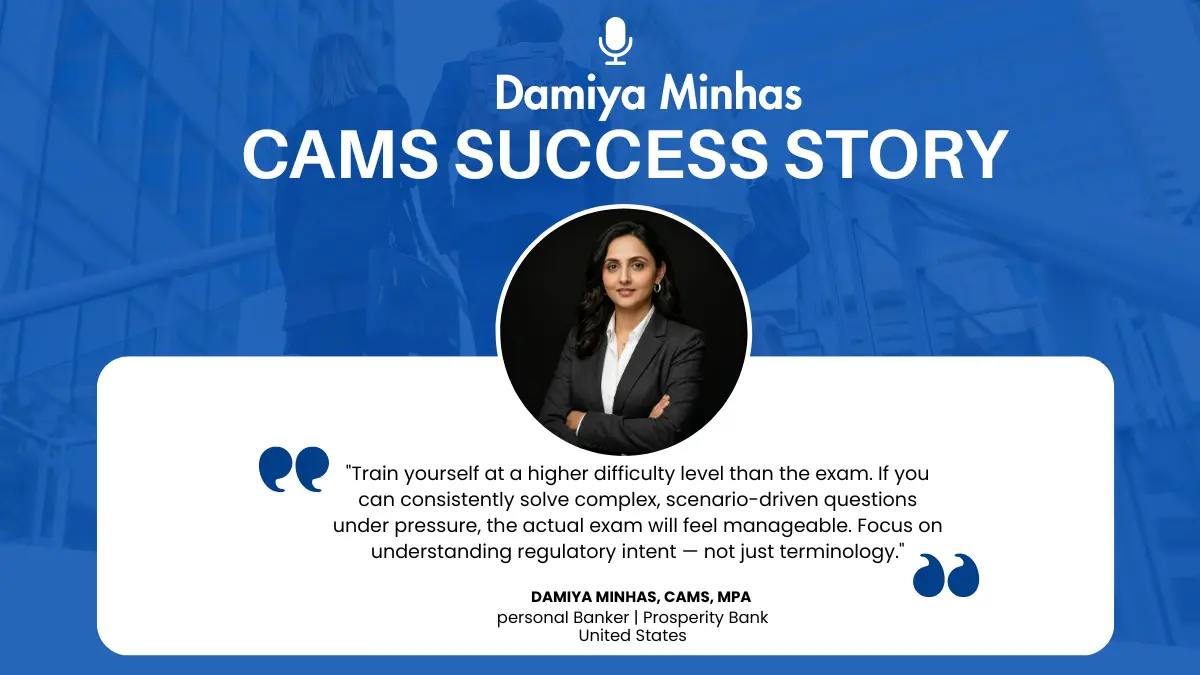
Damiya’s CAMS Success Secret Formula
Ten years in banking. Two countries. Thousands of customer relationship handled. And one exam that put it all to Damiya’s CAMS test.
When Damiya Minhas sat down for her CAMS exam, she wasn’t just prepared for the CAMS Success – she was ready for it. Not all paths to CAMS certification look the same – and Damiya Minhas’s journey is proof of that.
With over a decade of banking experience spanning both Pakistan and the United States, Damiya built her career at the intersection of transaction risk, sanctions screening, and AML compliance. When she decided to formalize that expertise with the CAMS certification, she approached it the same way she approaches financial crime risk: methodically, strategically, and with a focus on outcomes.
The result? A first-attempt CAMS success with a score of 90%
We sat down with Damiya to hear how she prepared, what surprised her about the exam, and what advice she has for other working professionals who want similar CAMS success.
🎙️CAMS Success: Interview with Damiya Minhas
Can you introduce yourself and your current role?
My name is Damiya, and I currently work as a Transaction Risk Analyst within a state-regulated financial environment. My role focuses on transaction monitoring, fraud detection, investigative analysis, and compliance-based risk assessment.
I bring over 10 years of banking experience, including five years in Pakistan’s banking sector from 2010 to 2014, where I gained exposure to heightened AML and sanctions risk environments. During that period, I was actively involved in sanctions screening, enhanced due diligence, and monitoring activities aligned with evolving regulatory and geopolitical risks. That experience significantly shaped my understanding of cross-border risk and compliance controls.
What motivated you to pursue the CAMS certification?
My motivation stemmed from a desire to deepen my regulatory understanding of global AML frameworks. Having worked in environments with elevated sanctions and financial crime risks, I wanted to strengthen my knowledge of international standards such as FATF recommendations and correspondent banking controls.
CAMS provided a structured way to connect my practical experience with formal regulatory principles, and it enhanced my ability to analyze financial crime risk from both an operational and strategic perspective.
How does CAMS align with your long-term goals?
CAMS aligns directly with my long-term goal of advancing into roles such as AML Investigator, Fraud Manager, or Compliance Officer — positions where I can contribute to strengthening compliance frameworks, improving risk controls, and proactively addressing emerging financial crime threats.
My international exposure, combined with U.S.-based regulatory experience, positions me to approach financial crime risk with both global awareness and practical investigative insight.
How long did you prepare, and what was your study schedule?
I initially reviewed the CAMS manual to understand the framework, but I began structured preparation in November 2025. For the first two months, I studied approximately five hours per week while working full-time. The final month was dedicated entirely to revision and self-testing – no new material, just strengthening weak areas and reinforcing high-yield topics.
In total, I completed close to 800 practice questions, which helped sharpen my analytical speed and regulatory reasoning.
What was your learning style?
My learning style was highly question-driven and application-focused. Rather than rereading the manual repeatedly, I identified gaps through practice questions and revisited concepts strategically.
I also used AI tools to generate questions intentionally more complex than typical CAMS questions – sometimes at a higher difficulty level – to push my analytical thinking beyond the exam standard. This approach helped me build confidence in interpreting scenario-based questions rather than relying on memorization.
I focused heavily on AML typologies, U.S. regulatory frameworks, and the USA PATRIOT Act, as these areas tend to require strong conceptual understanding.
What was your exam-day experience like?
On exam day, I felt calm and focused. Because I had completed extensive scenario-based practice, answering questions felt almost automatic – driven by repetition and analytical conditioning.
The exam is very application-oriented. Many questions test judgment rather than recall. Thanks to structured revision and repeated exposure to complex scenarios, I was able to approach each question methodically. I passed on my first attempt with a score of 90%.
Which topics appeared more than expected?
There was strong emphasis on the risk-based approach, AML typologies, correspondent banking, customer due diligence and beneficial ownership, and U.S. regulatory requirements.
I noticed multiple direct and indirect questions related to U.S. regulations, including the USA PATRIOT Act — approximately 6 to 7 questions tied closely to that area. Understanding the intent behind regulatory provisions made those questions much easier to navigate.
What surprised you about the CAMS exam?
What surprised me most was how much the exam tests practical judgment. It is not about memorizing definitions – it is about selecting the most appropriate compliance action in a given scenario.
The questions often include two technically correct options, and you must choose the one that best aligns with regulatory expectations and risk-based reasoning.
What is your one golden tip for CAMS candidates?
| 🏆 Golden Tip Train yourself at a higher difficulty level than the exam. If you can consistently solve complex, scenario-driven questions under pressure, the actual exam will feel manageable. Focus on understanding regulatory intent — not just terminology. |
How can working professionals balance work and CAMS preparation?
Consistency is key. Studying five focused hours per week for several months was sustainable while working full-time. The final month should be reserved for targeted revision and intensive practice — not learning from scratch.
Working professionals should prioritize structured repetition over volume. A steady pace builds deeper retention and reduces exam stress.
Final Thoughts
Damiya’s story is a compelling reminder that CAMS preparation is not about the number of hours you study- it’s about the quality of your practice and the clarity of your strategy. Her disciplined, question-driven approach, combined with years of real-world AML experience, produced an outcome that speaks for itself.
Whether you are just beginning your CAMS journey or in the final stretch of revision, Damiya’s advice offers a practical, field-tested framework: study harder than the exam demands, understand the intent behind the rules, and trust the process.
Every CAMS success story has a turning point – For Damiya, it was disciplined practice and strategic revision.
The CAMS Prep Masterclass provides live instructor led classes through which you can complete your CAMS preparation in less than 2 months. Further, CAMS PREP provides thousands of practice questions and flashcards which makes your journey a lot easier.
Your story is waiting to be written in our next blog. So, are you ready?
Related: how to pass CAMS
Related: CAMS eligibility
Related: common mistakes to avoid


